
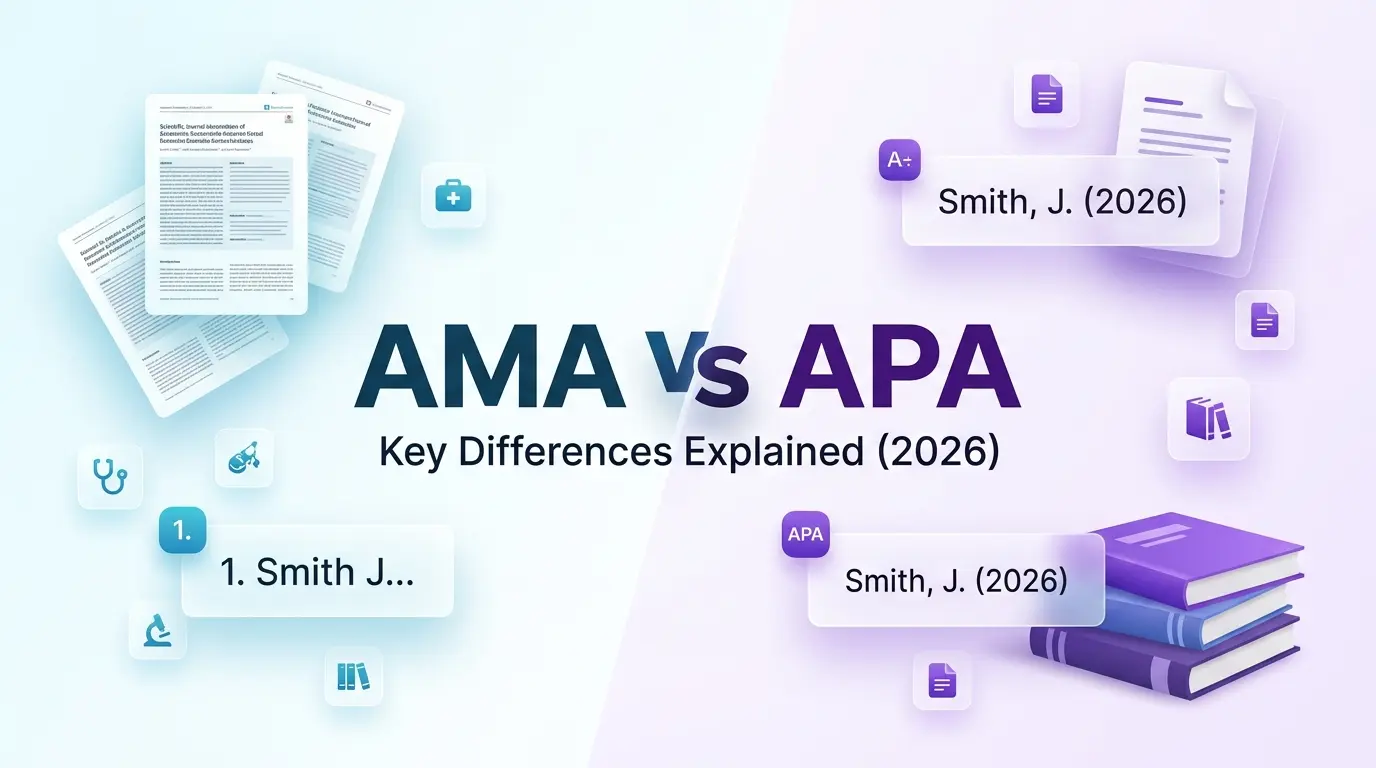
Your professor said "cite in AMA." Your classmate is using APA. Your other classmate is using MLA. You googled the difference and somehow ended up more confused than when you started.
Citation formats exist for a reason — they tell your reader exactly where to find every source you used, in a format specific to your academic field. The problem is that AMA (American Medical Association) and APA (American Psychological Association) look similar on the surface but work very differently in practice. Using the wrong one in the wrong field is one of the fastest ways to lose points on an assignment that is otherwise solid.
This guide gives you a clear, side-by-side breakdown of AMA vs APA: how in-text citations work in each style, what a reference list entry looks like for both, which academic fields use which format, and the specific formatting rules that differ between them. Keeping track of your sources inside a structured Cornell Notes Template makes organizing these citations dramatically easier, and once your paper is written, running it through the best free grammar checkers ensures your writing is error-free. Real examples of both, not abstract rules. By the end, you will know exactly which style to use and how to apply it correctly.
If you already know which format you need and just want to generate a citation instantly, WritlifyAI's free AMA Citation Generator at https://www.writlifyai.com/tools/ama-citation-generator handles AMA references with no account required. But if you are still deciding which format your assignment actually requires — or if you need to understand both — keep reading.
Why AMA and APA Are Different — And Why It Actually Matters
AMA and APA were designed for different academic communities with different priorities. AMA style was created by the American Medical Association for medical journals, clinical research, and healthcare publications. Its priority is speed and precision — medical readers need to verify sources quickly, so citations are kept minimal in the text (just a number) and the full reference detail is in a numbered list at the end. APA style was created by the American Psychological Association for psychology, social science, and behavioral research. Its priority is transparency about recency — in fields where a 2015 study and a 2023 study on the same topic could lead to completely different conclusions, readers need to see the publication year in every in-text citation. That philosophical difference explains almost every specific rule that distinguishes the two formats.
!Different academic fields
AMA is used in medicine, nursing, dentistry, and health sciences. APA is used in psychology, education, social work, and behavioral science.
!Different in-text citation systems
AMA uses superscript numbers — clean and minimal. APA uses author-date — shows the year in the text because recency matters in social science.
!Different reference list formats
AMA numbers its references in order of first appearance. APA lists alphabetically by author last name — standard across most humanities and social science styles.
!Different author name formats
AMA uses initials only for first and middle names. APA uses last name plus initials. Small difference, big impact on how your reference list looks.
!Different journal title formatting
AMA abbreviates journal titles (standard medical abbreviations). APA writes journal titles out in full and italicizes them.
Tools That Make AMA and APA Citations Faster
WritlifyAI — AMA Citation Generator
Best: Free AMA Citations, No SignupDisclosure: this is our tool. Here is the honest case for it. If your assignment requires AMA citations — journal articles, books, websites, or other source types — the AMA Citation Generator formats them correctly according to AMA 11th edition standards. You enter the source details, it generates the formatted reference and in-text citation number. No account, no signup, no credit card. One practical note for people searching 'AMA to APA converter': there is no automated tool that reliably converts between citation styles, because the information captured in each format differs. AMA references include page ranges for journal articles; APA includes the DOI and publication year in a different position. The most reliable approach is to generate your citations fresh in the format you actually need — which is what this tool does for AMA.
- Formats journal articles, books, websites, and other sources in AMA style
- Generates both the in-text superscript number reference and the full reference list entry
- No account, no email, no credit card — open the page and start generating
- Based on AMA 11th edition (2020) — the current standard for medical and health science writing
Scribbr — APA Citation Generator
Best: Free APA CitationsFor APA citations specifically, Scribbr's APA Citation Generator is the most reliable free option widely used by students in 2026. It handles APA 7th edition formatting — the current standard — and covers journal articles, books, websites, and other common source types. Unlike some citation generators, Scribbr also explains the APA formatting rules as it generates, so you learn the style alongside the output. Requires no account for basic citation generation. Scribbr also has strong supplementary content explaining APA rules in detail, which is useful if your professor is strict about citation accuracy.
- Generates APA 7th edition citations — the current standard since 2020
- Covers journal articles, books, websites, YouTube videos, and more
- No account required for basic citation generation
- Includes explanations of APA rules alongside the generated citation
WritlifyAI — Grammar Fixer
Best: Clean Up Your Reference ListOne step most students skip: proofreading their reference list. Citation errors — wrong punctuation, missing periods, inconsistent formatting — are easier to catch with fresh eyes or a grammar tool than after you have been staring at your bibliography for an hour. The Grammar Fixer catches punctuation errors, inconsistent capitalization, and formatting issues that are easy to miss when you are checking twenty references manually. Paste your reference list, click fix, and review the corrections before finalizing. No account required.
- Catches punctuation errors, extra spaces, and inconsistent formatting in reference lists
- No account or signup required — paste and fix in seconds
- Completely free — no usage limits
- Works on any device in any browser
10 Tips to Write Faster Today
How In-Text Citations Work: AMA vs APA
This is where most students get confused — the in-text citation is the part that appears inside your paragraph, not in the reference list. In AMA style, you use a superscript number after the relevant information. The first source you cite becomes 1, the second becomes 2, and so on. Example AMA in-text citation: "Diabetes affects approximately 537 million adults worldwide.¹" That superscript 1 tells the reader to look at reference number 1 in your reference list. In APA style, you use the author's last name and the publication year in parentheses instead. Example APA in-text citation: "Diabetes affects approximately 537 million adults worldwide (International Diabetes Federation, 2021)." If you are quoting directly rather than paraphrasing, APA also requires a page number: (International Diabetes Federation, 2021, p. 12). AMA does not require a page number for paraphrased content.
How Reference List Entries Look: AMA vs APA (Journal Article)
The reference list entry is the full citation at the end of your paper. Here is the same journal article formatted in both styles so you can see the structural difference clearly. The article: Smith AB, Jones CD, Brown EF. Effects of sleep deprivation on cognitive performance. Journal of Sleep Research. 2022;31(4):e13501. doi:10.1111/jsr.13501. AMA format reference entry: Smith AB, Jones CD, Brown EF. Effects of sleep deprivation on cognitive performance. J Sleep Res. 2022;31(4):e13501. doi:10.1111/jsr.13501. Notice: journal title is abbreviated (J Sleep Res), no italics on book/journal title, year appears after authors. APA format reference entry: Smith, A. B., Jones, C. D., & Brown, E. F. (2022). Effects of sleep deprivation on cognitive performance. Journal of Sleep Research, 31(4), e13501. https://doi.org/10.1111/jsr.13501. Notice: year is in parentheses right after author names, journal title is fully written out and italicized, DOI is a full URL, authors are separated with commas and an ampersand before the last author.
“If you are writing in a health science or medical field and need to generate AMA references like the example above, use WritlifyAI's free AMA Citation Generator. Enter your source details and it formats the reference correctly — no account needed.”
Try AMA Citation GeneratorHow to Cite a Book: AMA vs APA
Books follow slightly different rules from journal articles in both styles. AMA book reference format: Author AA, Author BB. Title of Book: Subtitle if Any. Edition (if not the first). Publisher Name; Year of publication. Example: Kasper DL, Fauci AS, eds. Harrison's Principles of Internal Medicine. 21st ed. McGraw-Hill; 2022. APA book reference format: Author, A. A., & Author, B. B. (Year). Title of book: Subtitle if any (Edition if not the first). Publisher. Example: Kasper, D. L., & Fauci, A. S. (Eds.). (2022). Harrison's principles of internal medicine (21st ed.). McGraw-Hill. Key differences for books: AMA does not italicize the title. APA italicizes the title. AMA lists the edition using abbreviated notation (21st ed). APA uses the same notation but places it in parentheses after the title. AMA puts the year at the end. APA puts the year directly after the authors.
How to Cite a Website: AMA vs APA
Website citations are where both styles get more complicated — and where most citation generators are most prone to errors. The information required is similar in both but structured differently. AMA website citation format: Author AA or Organization Name. Title of page or document. Website Name. Published/Updated Month Day, Year. Accessed Month Day, Year. URL. Example: World Health Organization. Global health observatory: Life expectancy. WHO. Updated April 7, 2023. Accessed May 15, 2026. https://www.who.int/data/gho/data/themes/topics/indicator-groups/indicator-group-details/GHO/life-expectancy. APA website citation format: Author, A. A., or Organization Name. (Year, Month Day of publication or update). Title of page. Website Name. URL. Example: World Health Organization. (2023, April 7). Global health observatory: Life expectancy. WHO. https://www.who.int/data/gho/data/themes/topics/indicator-groups/indicator-group-details/GHO/life-expectancy. Key difference: AMA always includes the access date for websites. APA 7th edition only includes an access date if the content is likely to change over time (such as a wiki or a live database).
AMA vs APA vs MLA: Which One Do You Actually Need?
If your assignment also mentions MLA, here is the quick field guide. Use AMA if you are in: medicine, nursing, pharmacy, dentistry, allied health sciences, or any clinical or health science research course. Your professor will usually specify this. Use APA if you are in: psychology, psychiatry, social work, education, criminology, communications, or behavioral science. APA is also widely used in business and some STEM fields. Use MLA if you are in: literature, English, comparative literature, languages, cultural studies, philosophy, or the humanities broadly. MLA uses a Works Cited page rather than a References page and includes page numbers differently. The fastest way to confirm which style your assignment requires: check your syllabus, check the assignment instructions, and if neither specifies, ask your professor directly. Do not guess — a wrong citation style on a research paper can cost you points even if every citation is otherwise correct.
“Confirmed you need AMA? Generate your references instantly with WritlifyAI's free AMA Citation Generator — no account required, based on AMA 11th edition.”
Try AMA Citation GeneratorMultiple Authors and Et Al.: AMA vs APA Rules
Both styles handle multiple authors differently, and this is a common source of errors. AMA rules for multiple authors: list all authors if there are six or fewer. If there are seven or more authors, list the first three authors and then write 'et al.' — which is Latin for 'and others.' Example with 3 authors: Smith AB, Jones CD, Brown EF. Example with 8 authors: Smith AB, Jones CD, Brown EF, et al. APA rules for multiple authors: in the reference list, list all authors up to 20. If there are 21 or more, list the first 19, then add an ellipsis (...) and the final author's name. In the in-text citation: with one or two authors, name both every time. With three or more authors, use only the first author's name followed by 'et al.' from the first citation onward. Example APA in-text with 3+ authors: (Smith et al., 2022). This is one of the most frequently confused rules between the two styles — AMA is stricter about when et al. kicks in, but APA's reference list allows many more names before truncating.
AMA vs APA: Complete Side-by-Side Comparison
| Feature | AMA Style | APA Style | Why It Differs |
|---|---|---|---|
| Full name | American Medical Association | American Psychological Association | Each style is named for the organization that created it |
| Used in | Medicine, nursing, dentistry, health sciences | Psychology, education, social science, behavioral research | Different fields have different publication conventions |
| In-text citation | Superscript number ¹ ² ³ | Author-date (Smith, 2023) | AMA prioritizes clean text; APA shows recency of source |
| Reference list order | Numbered by order of first appearance in text | Alphabetical by author last name | AMA mirrors the numbered in-text system; APA uses author search |
| Author names | Last name + initials only (Smith AB) | Last name + initials (Smith, A. B.) | Minor formatting difference — both use initials, not full first names |
| Publication year | At the end of the reference entry | Immediately after author name in parentheses | APA puts year early because recency is a primary concern in social science |
| Journal titles | Abbreviated (N Engl J Med) | Full title, italicized (New England Journal of Medicine) | Medical databases use standard abbreviations; APA prefers full clarity |
| Book titles | Not italicized | Italicized | Different typographic conventions by field |
| DOI format | doi:10.xxxx/xxxxx (no https) | https://doi.org/10.xxxx/xxxxx (full hyperlink) | APA 7th edition standardized to full URL format in 2020 |
| Current edition | AMA 11th edition (2020) | APA 7th edition (2020) | Both updated to their current editions in 2020 |
Quick Decision Guide: AMA vs APA — Which One Do You Need?
| Your Field or Assignment | Use This Style | Why |
|---|---|---|
| Medicine / Nursing / Pharmacy | AMA (11th edition) | Standard for all major health science journals |
| Psychology / Psychiatry | APA (7th edition) | APA was created by psychologists, for psychologists |
| Education / Social Work | APA (7th edition) | Social science fields adopted APA as the standard |
| English / Literature / Humanities | MLA (9th edition) | MLA is the humanities standard — not AMA or APA |
| Biology / Life Sciences | AMA or CSE — check your syllabus | Life science journals vary; professor will specify |
| Business / Management | APA (7th edition) usually | Most business schools default to APA unless specified |
| Not sure — professor did not specify | Ask before submitting | Wrong style costs more points than asking the question |
5 Citation Mistakes That Cost Students Points — And How to Avoid Them
Do not mix AMA and APA in the same paper. It happens more often than you think — especially when you use multiple citation generators. Pick one format for the entire paper and be consistent. Your reference list and your in-text citations must follow the same style.
Verify DOI format before submitting. AMA uses doi:10.xxxx/xxxxx. APA 7th edition uses https://doi.org/10.xxxx/xxxxx. Using the wrong format is one of the most common citation errors that professors notice immediately.
Check whether you are using the current edition. AMA 11th edition (2020) and APA 7th edition (2020) are both current. Earlier rules — like APA 6th edition — differ on DOI formatting and reference list structure. If your professor says 'APA' without specifying the edition, assume 7th.
Always double-check auto-generated citations. Citation generators — including ours — can only format what they are given. If you enter an incorrect publication year or misspell an author name, the generator will format that error correctly. Verify the source information before you generate, not after.
Proofread your reference list separately from your main text. It is easy to miss a missing period, an extra comma, or an inconsistent abbreviation when you are reading your paper straight through. Paste your reference list into a separate document and proofread it in isolation before submitting.
Frequently Asked Questions
What is the difference between AMA and APA citation?
The main difference between AMA and APA citation is the in-text format and the field of use. AMA uses superscript numbers in the text (¹) and is used in medical and health sciences. APA uses author-date parenthetical citations (Smith, 2023) and is used in psychology, education, and social sciences. Their reference list formats also differ significantly in how authors are listed and how the publication year is positioned.
How does AMA in-text citation differ from APA in-text citation?
In AMA, in-text citations are superscript numbers placed after the relevant information — for example: 'Hypertension affects 1.28 billion adults worldwide.¹' The number corresponds to the numbered reference list. In APA, in-text citations include the author's last name and year in parentheses — for example: 'Hypertension affects 1.28 billion adults worldwide (WHO, 2023).' APA also requires a page number for direct quotes.
When should I use AMA vs APA?
Use AMA (American Medical Association) format for papers in medicine, nursing, pharmacy, dentistry, and health sciences. Use APA (American Psychological Association) format for papers in psychology, education, social work, behavioral science, and communications. If your syllabus or assignment instructions do not specify which format to use, ask your professor before submitting — using the wrong style can affect your grade even if the citations are otherwise correct.
Can you show an example of the same citation in AMA and APA?
Yes. Using the same journal article as an example — Author: Smith AB, Jones CD. Title: Effects of sleep deprivation. Journal: Journal of Sleep Research. Year: 2022. Volume: 31. Issue: 4. DOI: 10.1111/jsr.13501. AMA format: Smith AB, Jones CD. Effects of sleep deprivation. J Sleep Res. 2022;31(4):e13501. doi:10.1111/jsr.13501. APA format: Smith, A. B., & Jones, C. D. (2022). Effects of sleep deprivation. Journal of Sleep Research, 31(4), e13501. https://doi.org/10.1111/jsr.13501.
What is the difference between AMA, APA, and MLA?
AMA is used in medical and health sciences — it uses numbered superscript citations and a numbered reference list ordered by appearance. APA is used in psychology, education, and social sciences — it uses author-date in-text citations and an alphabetical References list. MLA is used in literature, English, and the humanities — it uses author-page in-text citations and a Works Cited list. The field of your paper determines which style to use.
Is there an AMA to APA converter?
There is no reliable automated AMA to APA converter because the two formats capture source information differently — AMA abbreviates journal titles while APA spells them out, and the position of the publication year changes entirely. The most accurate approach is to generate your citations fresh in the format you need. WritlifyAI's AMA Citation Generator creates AMA-formatted references from scratch at https://www.writlifyai.com/tools/ama-citation-generator. For APA, Scribbr's APA generator is a reliable free option.
Which is harder to use — AMA or APA?
Most students in health science programs find AMA simpler for in-text citations — you just add a superscript number, which is less disruptive to the flow of reading than the author-date format. However, AMA's numbered reference list requires you to track which source was cited first throughout the entire paper, which becomes difficult to manage manually in long papers. APA's alphabetical reference list is easier to build and check, but the author-date in-text citations take more space and can interrupt reading. Overall, neither is harder — they are just different, and each one gets easier the more you use it.
How many authors before 'et al.' in AMA vs APA?
In AMA, list all authors if there are six or fewer. If there are seven or more, list the first three authors followed by 'et al.' In APA in-text citations, use 'et al.' from the first citation onward when there are three or more authors — for example, (Smith et al., 2022). In the APA reference list, list all authors up to 20; for 21 or more, list the first 19, add an ellipsis, and include the last author's name.
AMA vs APA: The Short Version
AMA is for medical and health science writing. It uses superscript numbers in the text and a numbered reference list ordered by first appearance. APA is for psychology, education, and social science writing. It uses author-date in-text citations and an alphabetical References page.
The most important rule is consistency: pick the style your assignment requires and apply it uniformly across every in-text citation and every entry in your reference list. One comma in the wrong place, one journal title written out when it should be abbreviated — these are the citation errors that cost students points on otherwise strong papers.
If you need AMA citations right now, generate them at https://www.writlifyai.com/tools/ama-citation-generator — no account, no signup, based on AMA 11th edition. For APA, Scribbr's APA generator is the most reliable free option. Either way: generate your citations, verify the source information, proofread the reference list separately, and submit with confidence.